
The Setary spreadsheet editor provides two ways to update categories, tags, and custom taxonomies on your WordPress and WooCommerce sites:
Shopify note: On Shopify, the equivalent of categories is collections, and tags work exactly the same way. The process below applies to both platforms.
- To add, edit and delete actual categories, tags, or custom taxonomy terms. For example, you might want to create a new category for your blog posts.
- To update the categories, tags or custom taxonomies which are attached to your content. For example, you might want to add the selected blog posts to a specific category.
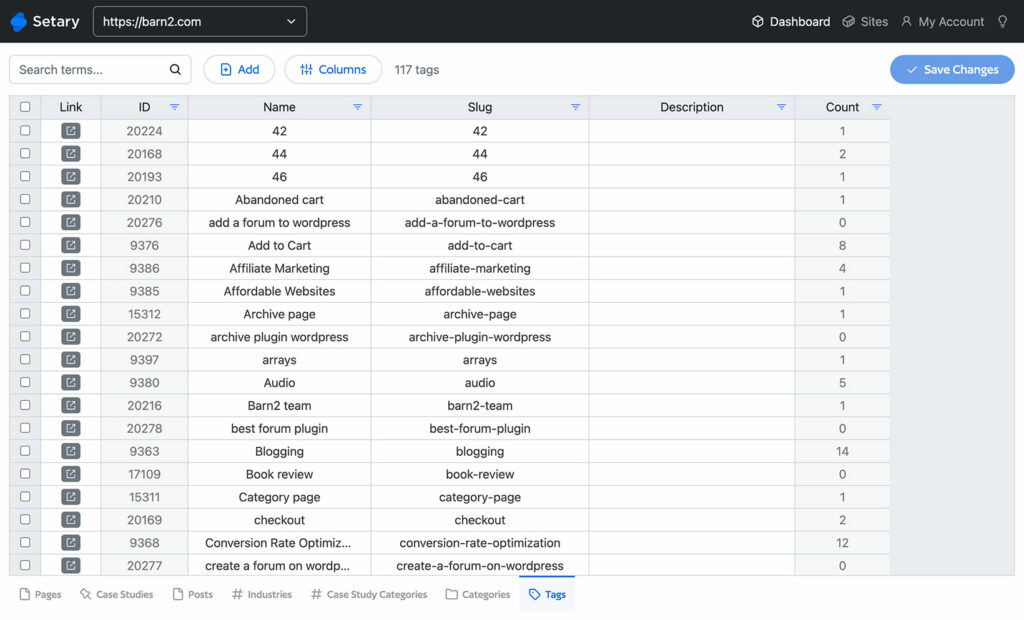
Add, edit and delete categories, tags, or custom taxonomy terms
- In the WordPress admin for your site, go to Settings > Setary.
- Ensure the categories/taxonomies that you wish to edit in Setary are enabled.
- Now go to the Setary app and click on the relevant tab below the spreadsheet.
- Manage your categories, tags and taxonomy terms as needed.
Update the categories, tags or custom taxonomies which are attached to your content
Setary makes it possible to update the categories and custom taxonomies assigned to your posts, custom posts, and ecommerce products. To do so, you will need to follow our special category syntax. The example should help get you started.
Let’s assume we want to add a WooCommerce product to the following categories:
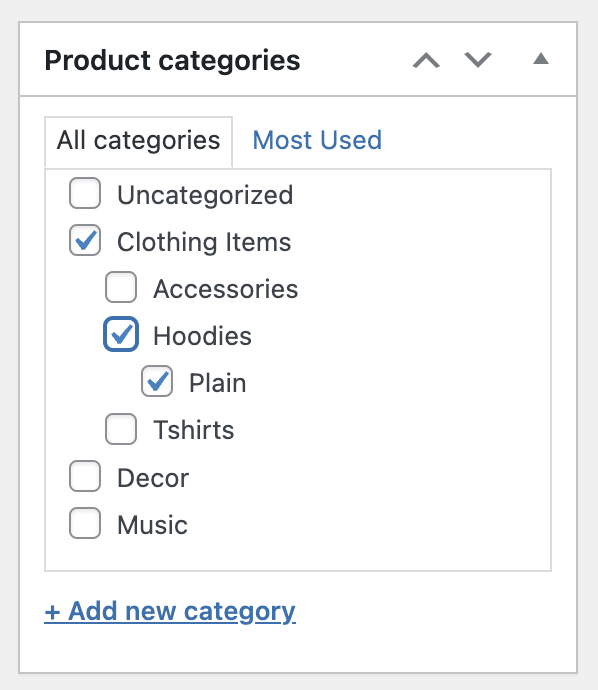
This product is in three categories, and two of those categories are nested. There are 2 rules to take note of when defining categories in Setary:
- Categories are separated by the “pipe” character: |
- Nested categories are separated by the “chevron” character: >
With that in mind, in order to add a product to the categories required, the categories field in Setary would look like this: Clothing Items | Clothing Items > Hoodies | Clothing Items > Hoodies > Plain

When nesting categories, the item you’re editing will be added to the last category in the nest. As such, we need to add each category separately and separate them with the pipe character.
Note: If a category does not exist, Setary will create it for you. Double-check your casing and spelling!